

Big Data and AI‑Driven Optimization for Complex Systems: Theory, Algorithms, and Industrial Applications


Faculty of Engineering Management, Poznań University of Technology, PolandMathematics; Operational Research, Optimization; Optimal Control; Stochastic Optimal Control; Finance, Game Theory; Computer Science; Statistics; Machine Learning; Logistics; Developing Countries; Cosmology; Christianity

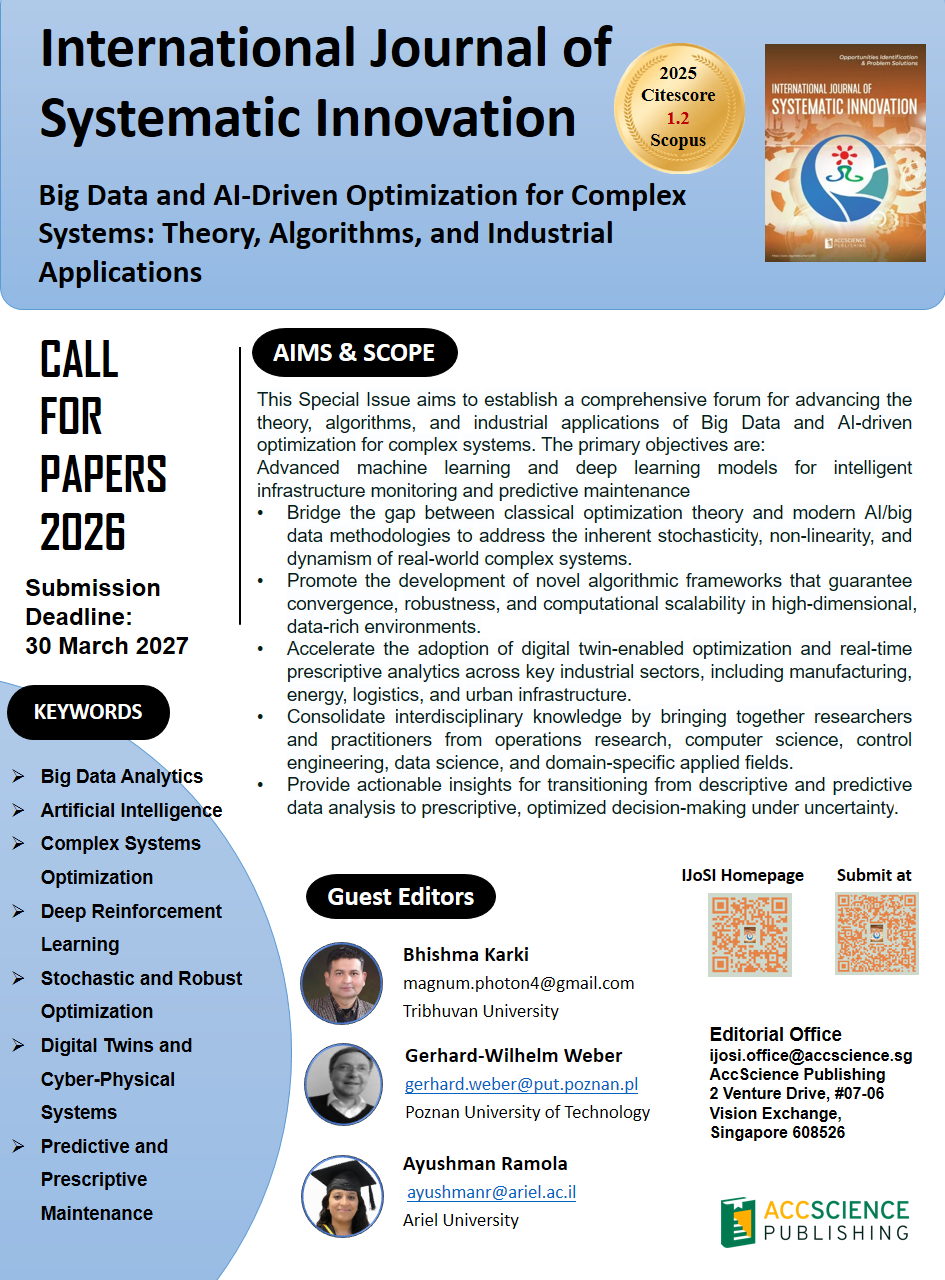
The proliferation of interconnected sensors, edge devices, and cyber-physical systems has ushered in an era where complex industrial and societal systems generate unprecedented volumes of multi-modal, high-velocity data. Traditional optimization paradigms, often reliant on simplified mathematical models and steady-state assumptions, are increasingly inadequate for capturing the stochastic, non-linear, and dynamic nature of these real-world networks. This Special Issue aims to bridge the critical gap between cutting-edge Big Data analytics, advanced Artificial Intelligence (AI), and the rigorous theory of optimization to address the grand challenges in complex systems engineering.
We invite original research and comprehensive reviews that explore the synergistic integration of machine learning, deep reinforcement learning, and generative AI with classical operations research and control theory. The theoretical focus will encompass novel algorithmic frameworks that guarantee convergence, robustness, and computational efficiency in high-dimensional spaces. Particular emphasis will be placed on "digital twin" enabled optimization, where AI models continuously learn from streaming data to provide real-time prescriptive analytics.
On the application front, this SI seeks contributions that demonstrate scalable, deployable solutions across diverse sectors. We are particularly interested in use cases involving smart manufacturing (predictive maintenance and scheduling), intelligent energy grids (demand-response and load balancing), autonomous logistics (fleet routing and supply chain resilience), and urban computing (traffic management and resource allocation). By consolidating state-of-the-art methodologies and industrial case studies, this issue will serve as a definitive reference for researchers and practitioners aiming to transition from descriptive data analysis to actionable, optimized decision-making in uncertain environments.